01
External field
What is changing?
Controlled and transformed wildfire-like fields provide the evolving substrate against which sensing and belief maintenance are examined.
Current research
The current program studies belief maintenance under partial and impaired adaptive sensing: not only whether information is delivered, but whether it remains useful for maintaining an uncertainty-aware representation of a changing situation.
Wildfire-like fields provide the principal controlled domain. The underlying problem concerns networked monitoring more generally: observations are generated, transmitted, delayed, corrupted, lost, retained, and used to update a maintained state.
01
Central separation
A monitoring system can remain active and continue receiving information while the quality of its maintained picture changes for different reasons. The research therefore keeps delivery-side activity, belief quality, timeliness, usefulness, and effort as distinct views of the sensing loop.
Information can arrive without remaining equally useful for belief maintenance.
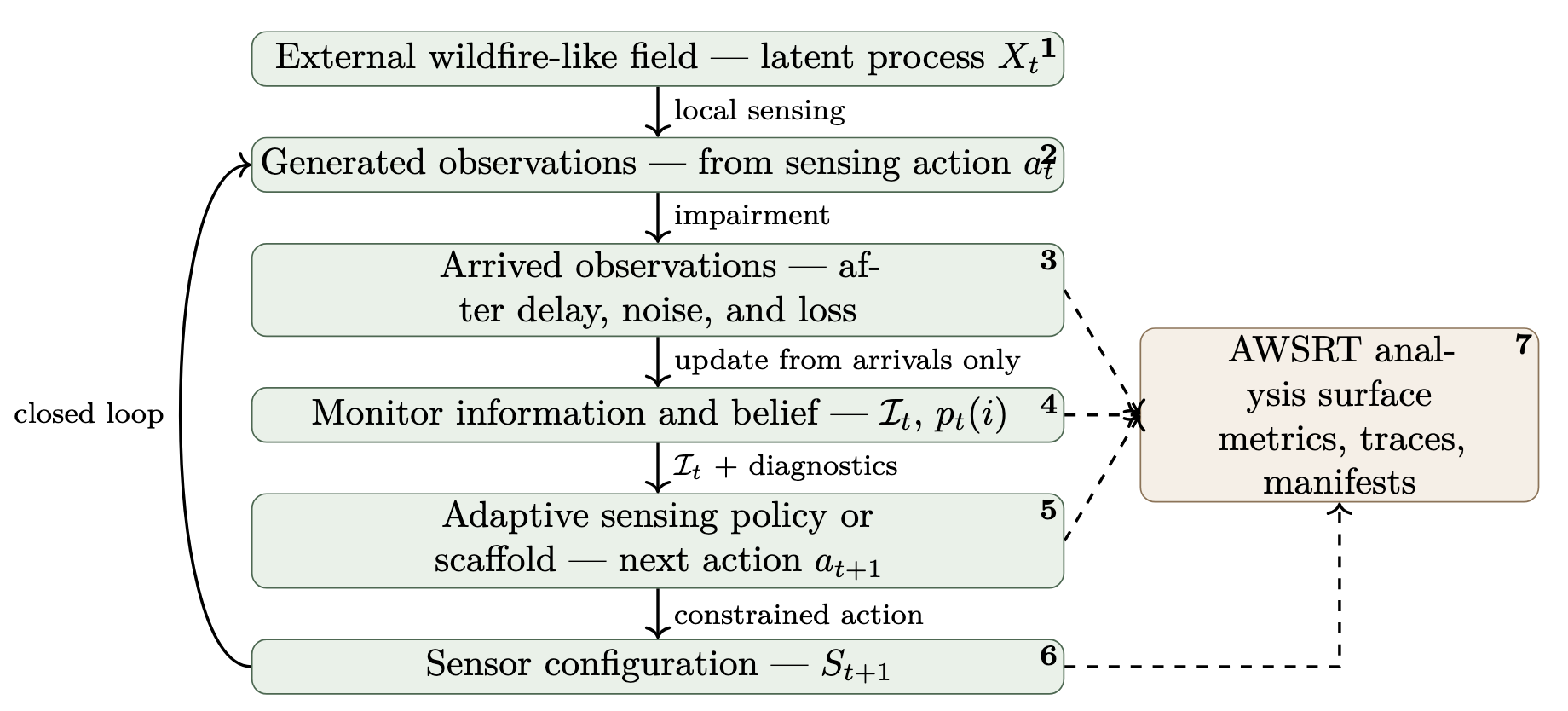
Closed-loop methodology
Only arrived observations update the maintained picture. Sensing creates observations, but delay, noise, and loss can separate what was generated in the field from what becomes available to the monitor.
The figure retains the thesis notation so the public explanation can be traced directly to the formal research model.
02
Research instrument
AWSRT is a bounded diagnostic research instrument used to vary sensing geometry, information impairment, retained belief, policy behaviour, and wildfire-like field structure under controlled conditions. It is designed to make separations among generated observations, arrived observations, maintained belief, sensing action, and diagnostic evidence visible and reproducible.
01
External field
Controlled and transformed wildfire-like fields provide the evolving substrate against which sensing and belief maintenance are examined.
02
Epistemic
Belief and uncertainty representations expose how partial support, retention, and impaired arrival shape the monitor’s maintained picture.
03
Operational
Policies, deployment geometry, movement constraints, sensing windows, and impairment conditions define the experimental sensing situation.
04
Analysis
Metrics, traces, manifests, and comparison workflows preserve the conditions needed to interpret delivery, belief quality, usefulness-state diagnostics, and effort.
03
Experimental questions
01
How does where observation is requested shape the spatial structure of maintained support and uncertainty?
02
How does previously acquired evidence continue to support the maintained picture as the underlying field changes?
03
How do loss, delay, and noise alter the relationship between information-side activity and maintained belief quality?
04
Do policies that emphasize feasibility, belief, uncertainty, or information reveal different trade-offs across detection, coverage, belief quality, delivery, and effort?
05
How do transformed wildfire-like fields, deployment origins, and observation windows condition what can be reached, observed, and maintained?
04
What the experiments show
The result is not a single best score or sensing policy. The value of the instrument is in showing where different measures cease to tell the same story.
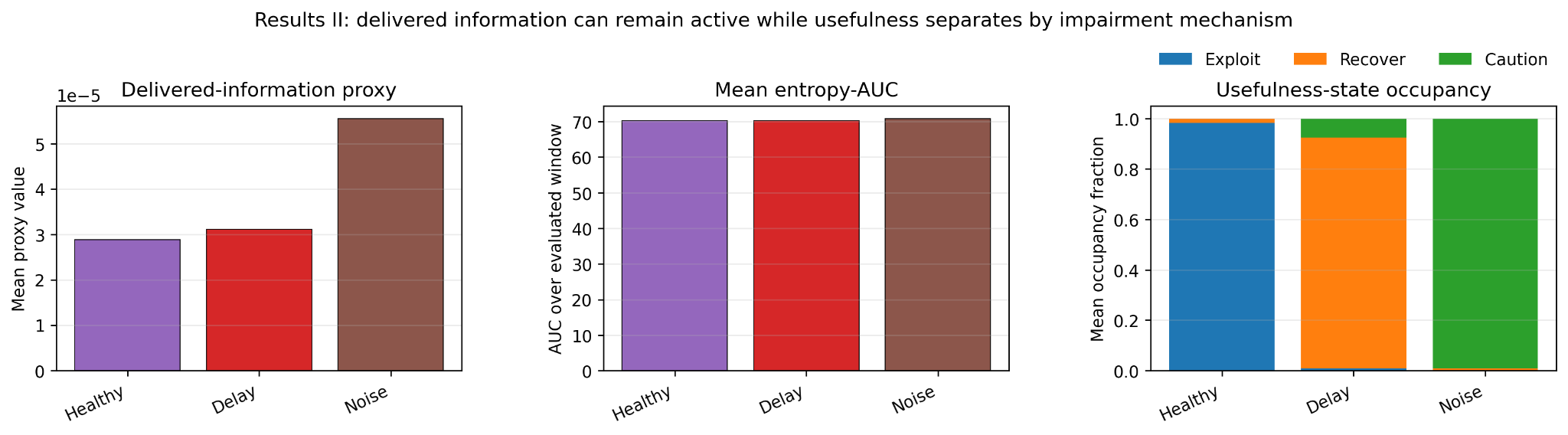
Information / usefulness wedge
Information activity alone does not identify information condition. Under the tested healthy, delayed, and noisy conditions, delivery-side activity remains visible while the internal usefulness-state interpretation separates by impairment mechanism.
Values are intended to be compared within each panel rather than across a common scale. Entropy-AUC is used here as a belief-quality diagnostic; exploit, recover, and caution are AWSRT-defined internal usefulness states.
01
Support geometry and belief retention interact. Similar amounts of information-side activity can produce different maintained uncertainty structures.
02
Delivered-information measures and entropy-side belief-quality measures can separate under matched experimental conditions.
03
Loss reduces update opportunity through non-arrival; delay creates staleness; noise preserves information activity while degrading update reliability.
04
Deployment geometry, field structure, and observation window can change access, timing, and the internal usefulness-state pattern. Results therefore remain tied to their experimental conditions.
05
Scope and limits
Supported here
The experiments support analysis of maintained belief, uncertainty, delivery, impairment, sensing geometry, policy behaviour, and metric separation within the tested research environment.
Not established here
They do not validate incident-command decisions, evacuation choices, operational wildfire retasking, human-interface effectiveness, or a complete measure of consequence or decision value.
Entropy is used as one diagnostic of maintained uncertainty, not as a complete measure of operational importance or usefulness.
Questions around the research
A working question-and-answer set developed alongside thesis defence preparation tests what the research claims, how the evidence should be read, and where the interpretation stops.
Explore the research
This page is the technical middle layer: deeper than the public overview, but still an interpretation of the research rather than a replacement for the thesis, papers, or reproducibility artefacts.